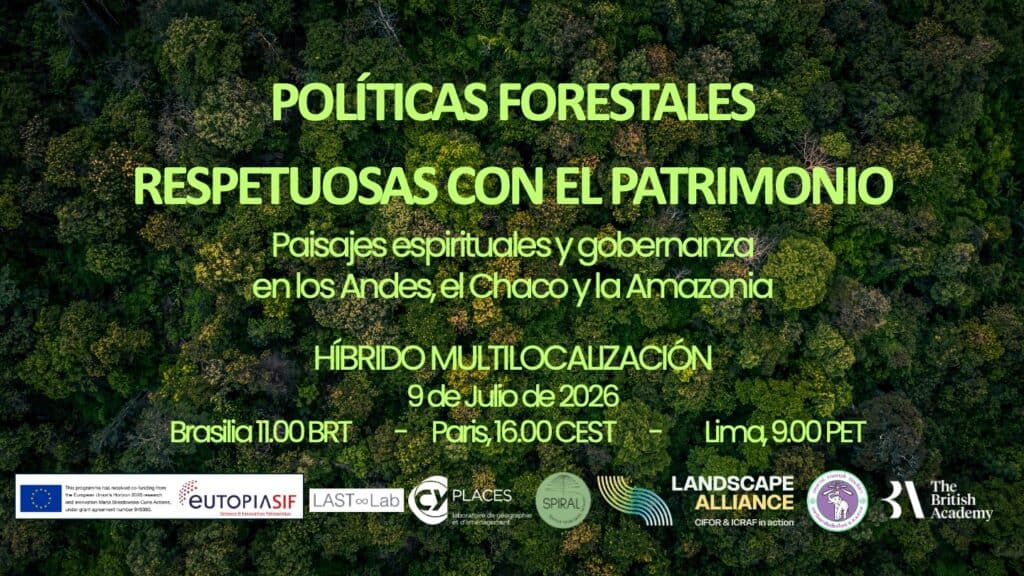
Ancestral Lands, Spiritual Landscapes, and Indigenous-Led Conservation in the Kunming–Montreal Global Biodiversity Framework (KM-GBF)
Short Abstract
This hybrid seminar and dialogue brings together Indigenous leaders, representatives of local communities, researchers, practitioners, and policy experts to examine Indigenous territorial governance, rights-based conservation, spiritual landscapes, and biodiversity conservation across the Andes, Amazonia, the Chaco, and Afro-descendant territories. The dialogue focuses on how Indigenous Peoples and Local Communities (IPLCs) contribute to the implementation of the Kunming–Montreal Global Biodiversity Framework (KM-GBF) through Indigenous and Community Conserved Areas (ICCAs), Indigenous Territories of Life (ITTs), and Other Effective Area-Based Conservation Measures (OECMs), while addressing the legal, political, and cultural conditions necessary for recognising Indigenous governance and collective territorial rights.
SPANISH
Este diálogo examinará la implementación del Convenio sobre la Diversidad Biológica (CDB) y de las Otras Medidas Eficaces de Conservación Basadas en Áreas (OECMs) a través del reconocimiento de las Áreas Conservadas por Pueblos Indígenas y Comunidades Locales (ICCAs) y los Territorios de Vida de los Pueblos Indígenas (ITTs). Analizará de manera crítica los desafíos que persisten para determinar quién es reconocido como indígena, quién posee derechos legítimos sobre la propiedad y la gobernanza de la tierra, y si los marcos jurídicos existentes reconocen realmente las instituciones y sistemas de gobernanza indígenas o si se limitan únicamente a reconocer su ocupación espacial.
The agenda will guide participants through key questions and experiences, including:
Proposed Date:
9 July 2026
Proposed Schedule
| Brasilia, Brazil | 11.00 BRT |
| Paris, France | 16.00 CEST |
| Lima, Peru | 9.00 PET |
| Buenos Aires, Argentina | 11.00 ART |
Format:
Hybrid Symposium hosted at Landscape Alliance Hub Perú and PLACES Lab, CY Cergy Paris University
Organiser:
Alessandra Manzini, PLACES Lab – SPIRAL Project
Cross-cultural study of sustainable management practices of spiritual landscapes
Institutional Co-Organisers
- CY Cergy Paris University, PLACES Lab
- Landscape Alliance, Lima
- Chiang Mai University, BA Heritage Project
- LAST lab University Ca’Foscari of Venice
Registration
The registration is recommended for getting the link
AGENDA
Programme of the event
11:00–11:07 (Brasília BRT) | 16:00–16:07 (Paris CEST) | 09:00–09:07 (Lima PET)
Alessandra Manzini ( PLACES, CY Cergy Paris University)
Gabriela Gonzales (Landscape Alliance)
Welcome and Opening Remarks: Framing Indigenous territorial governance, ICCAs, ITTs, and biodiversity conservation.
11:05–11:15 (Brasília BRT) | 16:05–16:10 (Paris CEST) | 09:05–09:10 (Lima PET)
Rocío Vasquez (Landscape Alliance)
Multi-stakeholder Conservation Dialogues in Peru, Colombia, Ecuador, and Bolivia.
11:15–11:25 (Brasília BRT) | 16:10–16:20 (Paris CEST) | 09:10–09:20 (Lima PET)
Alessandra Manzini (PLACES Lab, CY Cergy Paris Université – SPIRAL Project)
SPIRAL Project in the Andes and Amazonia: Framing the research questions and conceptual themes of the symposium. In Dialogue with
Anne Larson team-lead Governance, Equity and Wellbeing group at Landscape Alliance, expert of South America conservation policies
11:25–11:45 (Brasília BRT) | 16:20–16:40 (Paris CEST) | 09:20–09:40 (Lima PET)
Tsanim Wajai Asamat Representative of the GTA Wampis
Indigenous Territorial Governance and Conservation in the Kandozi Territory.
11:45–12:05 (Brasília BRT) | 16:40–17:00 (Paris CEST) | 09:40–10:00 (Lima PET)
Jaime Corisepa Neri Representative of the Harakbut Nation (Madre de Dios Region)
Territorial Governance, Forest Stewardship, and Indigenous Conservation in Madre de Dios.
12:05–12:20 (Brasília BRT) | 17:00–17:20 (Paris CEST) | 10:00–10:20 (Lima PET)
Luca Citarella Menardi
Regenerating the Sierra Nevada de Santa Marta: Indigenous-led Conservation and Territorial Governance in Colombia.
12:20–12:40 (Brasília BRT) | 17:20–17:35 (Paris CEST) | 10:20–10:35 (Lima PET)
Walter Sey Izquierdo (Arhuaco Representative)
Reclaiming Ancestral Lands: Introducing the Arhuaco Struggle through the case of the Seykun land restitution.
12:40–12:50 (Brasília BRT) | 17:35–17:50 (Paris CEST) | 10:35–10:50 (Lima PET)
Moderated Discussion & Questions
Dialogue with first panel of speakers
12:50–13:05 (Brasília BRT) | 17:50–18:05 (Paris CEST) | 10:50–11:05 (Lima PET)
Alejandro Argumedo (SWIFT Foundation & Asociación ANDES)
The Ayllu System of Parque de la Patata: Spiritual Values and Practices Associated with the Native Forests of the Andes.
13:05–13:20 (Brasília BRT) | 18:05–18:20 (Paris CEST) | 11:05–11:20 (Lima PET)
Lygia Fernandes Zamali (Centre for Social Studies, University of Coimbra)
Anthropoblind—It Is Not Development: The Self-Determination of Peoples as an Instrument of the Sacred.
13:20–13:35 (Brasília BRT) | 18:20–18:35 (Paris CEST) | 11:20–11:35 (Lima PET)
Lorenzo Langbehn (Instituto de Estudios para el Desarrollo Social)
Communal Uses of the Forest, Livelihoods, and Conservation in the Argentine Chaco.
13:35–14:00 (Brasília BRT) | 18:35–19:00 (Paris CEST) | 11:35–12:00 (Lima PET)
Final Discussion and Closing Remarks
Rights-based conservation, Indigenous territorial governance, ICCAs, OECMs, and implementation of the Kunming–Montreal Global Biodiversity Framework.
Key Policy Frameworks
The discussion focuses on three main instruments:
- Indigenous and Community Conserved Areas (ICCAs)
- Indigenous Territories of Life (ITTs)
- Other Effective Area-Based Conservation Measures (OECMs)
These instruments are increasingly central to achieving Target 3 of the KM-GBF.
However, their implementation raises important questions. For example, how can they strengthen Indigenous governance? And how can they protect collective land tenure and cultural continuity?
Recognition, Rights, and Sovereignty
A central issue is the difference between recognition and sovereignty.
On the one hand, many states formally recognise Indigenous stewardship of forests and sacred landscapes.
On the other hand, this recognition often remains limited.
In many cases, it is restricted to:
- usufruct rights
- co-management
- conservation responsibilities
However, Indigenous Peoples increasingly demand more than recognition as stewards. They seek recognition as:
- rights-holders
- landowners
- governing authorities
Therefore, the symposium explores key tensions between:
- territorial ownership
- customary law
- institutional autonomy
- legal pluralism
- definitions of Indigenous identity
Objectives and Expected Outcomes
By bringing together Indigenous knowledge holders, researchers, and practitioners, the symposium aims to:
- strengthen rights-based conservation approaches
- support Indigenous territorial governance
- improve implementation of ICCAs, ITTs, and OECMs
- contribute to KM-GBF Target 3
- promote legal recognition of Indigenous institutions
- enhance collective land rights and self-determination
- support biocultural diversity and adaptive governance
Ultimately, the goal is to align global biodiversity policy with Indigenous rights and lived territorial realities.

This research is supported by the EUTOPIA Science and Innovation Fellowship Programme and funded by the European Union Horizon 2020 programme under the Marie Skłodowska-Curie grant agreement No 945380