Manzini’s PhD research ” Dynamics of transitions in ecovillages of Senegal” explores transformative multiverse insights emerging from the Senegalese ecovillage movement and from alternative anti-hegemonic socio-ecological experiences. The study investigates what can be learned from the successful socio-ecological transition pathways of ecovillages in Senegal, a region long shaped by climate change, desertification, and environmental stress.
Starting from a core research question – what do Senegalese ecovillages teach us about ecological transition? – the research reflects on methodological approaches capable of including a plurality of voices, worldviews, and cosmologies. Inspired by decolonial thought and ethical-philosophical principles, the methods aim to capture the complexity of different settlement systems, values, trajectories, and practices shaping diverse forms of transition.
To this end, the research develops a comparative multidimensional evaluative framework that integrates transformative indicators, ethical-philosophical dimensions, and knowledge drawn from African intellectual traditions and fieldwork experience. A further level of analysis includes a sensitivity assessment of anthropogenic pressures and climatic conditions, exploring correlations between social-ecological drivers and transition dynamics.
The findings identify three broad patterns of transition among the case studies:
-
Anti-hegemonic experiences of resistance and resilience,
-
Proactive adaptation strategies,
-
Extreme surrender, including cases of forced migration due to irreversible ecological crises.
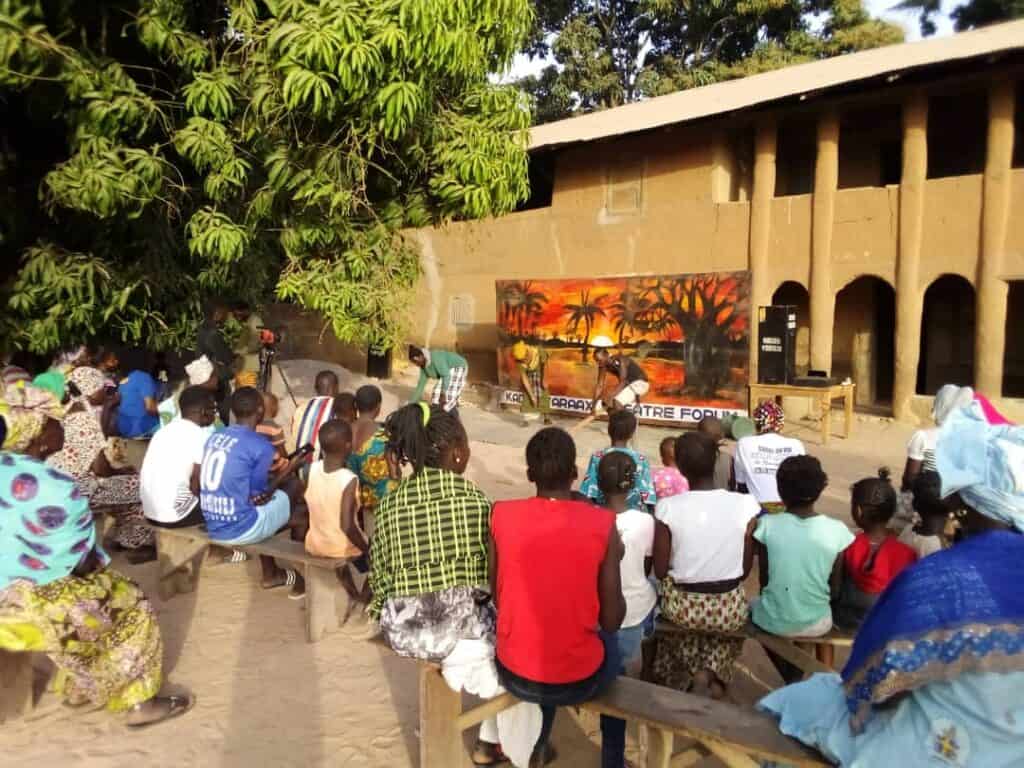
A central methodological innovation of the research is the use of forum theatre as a decolonial participatory tool. Collective performances addressing ecological transition, gender equality, land management, and fishing practices were organized with the local theatre company Kaddu Yaraax and community members. Dialogues in local languages enabled the emergence of situated narratives and local meanings of transition. These performances were complemented by community mapping exercises exploring imaginaries, desires, cosmologies, and everyday spatial practices.
The outcomes highlight the co-evolution of multiple endogenous African perspectives, contributing to the idea of Africa-World: a plurality of ways of translating and living “ecological transition” grounded in local languages, landscapes, and forms of life. The research connects empirical findings with emerging African paradigms of sustainability, calling for renewed reflection on contemporary ecological challenges.
The study situates Senegalese ecovillages within the broader geography of climate change and agrarian struggles in Sub-Saharan Africa, where resistance to extractive development models—such as land grabbing, monoculture, deforestation, pollution, GMOs, and unsustainable urbanization—is increasingly central. Ecovillage strategies emphasize ecosystem services, low-impact technologies, and culturally embedded forms of organization.
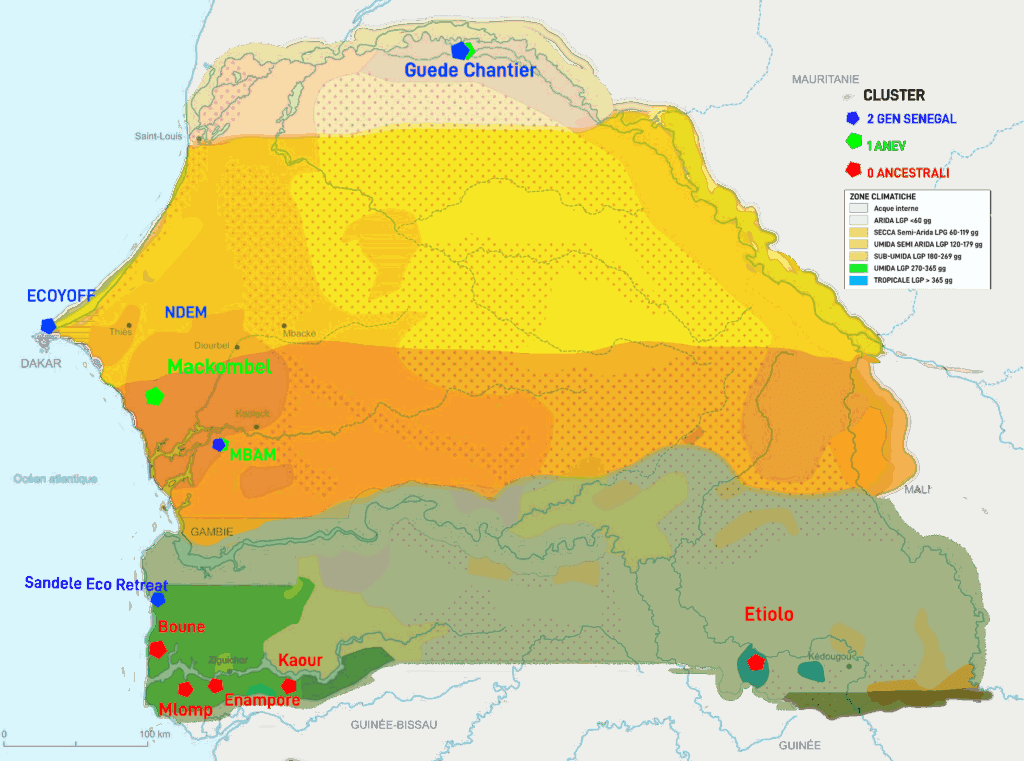
Based on a survey conducted during the PhD Dynamics of Transition in Ecovillages of Senegal, the research identifies three clusters of ecovillages:
-
Cluster 0: villages anchored in ancestral values (counterfactual group),
-
Cluster 1: villages involved in a national government-led ecovillage program,
-
Cluster 2: intentional ecovillages, both rural and urban.
Four in-depth case studies were analyzed: Mlomp (Casamance), Mackombel (Thies), Yoff (Dakar), and Ndem. In particular, Mlomp – a Jola Kassa village in Lower Casamance – illustrates how relational ontologies between humans and more-than-humans, grounded in reciprocity, symmetry, and cyclical temporality, support landscape metastability and long-term socio-ecological resilience.
The playlist of all the theatre shows is at this link: