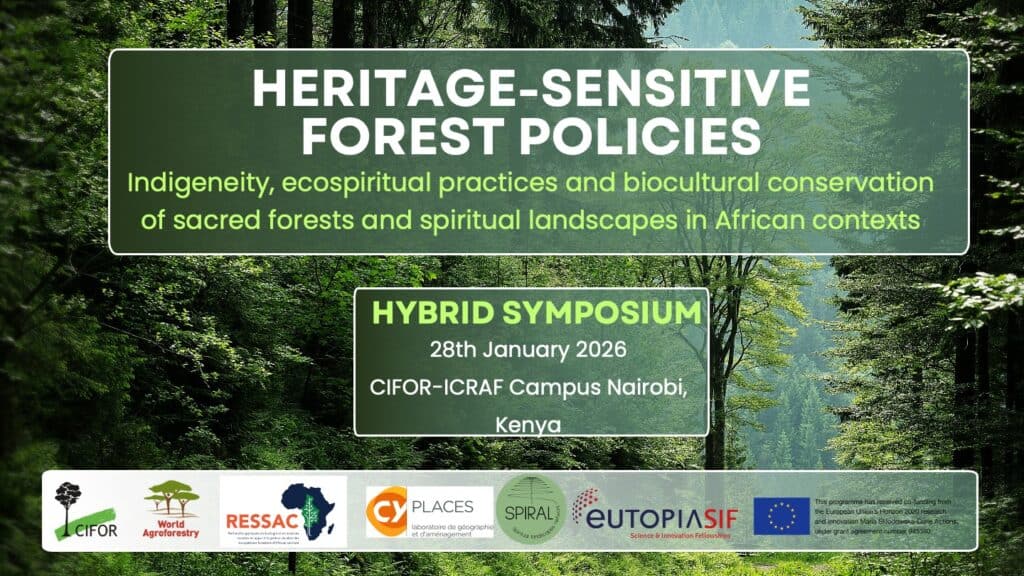
Indigeneity ecospiritual practices and biocultural conservation of sacred forests and spiritual landscapes in African contexts.
28th of January 2026 hybrid 10-18.30H
Background, Rational and Concept
This hybrid symposium, held at CIFOR-ICRAF Nairobi and online, brings together scholars, CIFOR-ICRAF researchers, Indigenous peoples, and local community members to engage in a transdisciplinary analysis of forest conservation policies and practices across African regions. By bridging scientific, traditional, and policy-oriented knowledge systems, the seminar will explore how legal and institutional frameworks shape – and are shaped by – cultural and socio-ecological power dynamics.
Why this symposium matters
Across Africa, sacred forests, groves, trees, and spiritual landscapes are not only ecological spaces but also living heritage systems shaped by Indigenous worldviews, ecospiritual practices, and complex power relations. This symposium explores how forest policies are influenced by—and can better respond to—colonial legacies, conservation regimes, climate change, armed conflict, and expanding commodity frontiers.
A core focus is the context-dependent understanding of indigeneity as a decolonial and relational approach that challenges rigid top-down definitions of Indigenous Peoples and Local Communities (IP&LCs), highlighting everyday heritage, stewardship, and livelihood practices.
Contributors will critically examine how power dynamics impact on Indigenous worldviews, ecospiritual practices, and forest governance systems. By highlighting the complex interactions among knowledge, belief, and practice across diverse socio-ecological settings, the symposium aims to deepen understanding of custodianship and its implications for heritage-sensitive policies in African contexts. It advances an adaptive, relational governance perspective in which sacred sites, forests, groves, and trees are understood as active agents influencing power relations.
Expected Outcomes
- Through collaborative dialogue and shared reflection, the symposium will surface best practices, contribute to bottom-up heritage sensitive policy design across African regions and foster new collaboration.
- The momentum will be created to discuss with authors and indigenous scholars the contents of the forthcoming book “Ecospiritual practices in African contexts Power Dynamics, Biocultural Change, and Integrated Landscapes Management” enriching the conclusions and discussion part with multivocal perspectives from practitioners, indigenous and area-based scholars.
Expected Outcomes for Heritage-Sensitive Conservation Africa
- Through collaborative dialogue and shared reflection, the symposium will:
- Advance adaptive and relational governance models for sacred forests and spiritual landscapes
- Identify best practices for heritage-sensitive conservation in Africa
- Contribute to bottom-up, Indigenous-informed forest policy design
- Strengthen collaboration among scholars, practitioners, and Indigenous knowledge holders
I. SYMPOSIUM PROSPECTUS
Title: Heritage-Sensitive Forest Policies in African Contexts.
Indigeneity, Ecospiritual Practices, and Biocultural Conservation of Spiritual Landscapes.
Date: 28th of January, 2026 | 10:00 AM – 6:00 PM (EAT)
Venue: CIFOR-ICRAF Nairobi Campus-Board Room & Online (Hybrid)
EVENTBRITE ONLINE REGISTRATION LINK Recommended for online/offline participation (please email if you wish to participate in presence)
Organizers: Dr. Alessandra Manzini, PLACES Lab; CY University SPIRAL funded by the EUTOPIA SIF alliance (Grant Agreement : 945380), in collaboration with CIFOR-ICRAF (Dr. Phosiso Sola , Prof. Anne Larson, Dr. Richard Sufo) and RESSAC project (funded by EU).
Concept Note
This symposium brings together a transdisciplinary cohort of scholars, CIFOR-ICRAF researchers, Indigenous peoples, and local community members to analyze forest conservation policies across African ecoregions. By bridging scientific, traditional, and policy-oriented knowledge systems, we explore how legal and institutional frameworks shape – and are shaped by – community-led forest governance and non-explicit conservation ecospiritual practices.
II. Agenda
Format: 10-minute presentation + 5-minute Q&A per speaker
10:00–10:20 | Welcome
- Phosiso Sola (CIFOR-ICRAF)
- Peter Minang (CIFOR-ICRAF director for Africa)
10:20–10:40 | Book Launch
Alessandra Manzini (CY Cergy Paris University, EUTOPIA SIF) Presenting the SPIRAL project and book project
Ecospiritual Practices in African Contexts
Multivocal perspectives from practitioners and scholars
- Alessandra Manzini, (CY Cergy Paris, EUTOPIA SIF)
- Paula Uimonen, (Stockholm University)
- Houria Djoudi, (FAO)
- Vitalis Pemunta ( University of Gothemborg)
10.45–12:30 | Panel 1 – East Africa
Moderator: Phosiso Sola CIFOR-ICRAF
- Nelly Masayi (Kibabii University, Kenya)
The Role of Eco-spiritual Approaches in the Sustainable Conservation and Management of the Mt. Elgon Forest Ecosystem, Kenya - Augustina Alvarez (Tanzania)
Sacred Forests and Ecospiritual Governance: Enduring Elements of the Pare Worldview in the Kilimanjaro Region - Rebecca Campbell (KU Leuven) & Paula Uimonen (University of Stockholm)
Mangrove Worldings: Ecospiritual Practices and Climate Change Adaptation in Coastal Tanzania - Asma Bile Hirsi, (Independent scholar) Natural Sites and Relational Landscapes in Somalia: Local Community Perspectives on Heritage, Cultural Memory, and Conservation
- Aster Gebrekirstos (CIFOR-ICRAF, Ethiopia) TBC
Dialogue & Q&A
12:30–13:30 | Lunch
13:30–13:50 | Keynote
- Lucie Temgoua (ERAIFT) Sacralisation, desacralisation and conservation of sacred forests in Central Africa
13:50–15:00 | Panel 2 – Central Africa
Moderator: Richard Sufo RESSAC project
- Vitalis Pemunta (University of Gothenburg; DR Congo)
Indigenous Voices in Sacred Forests: Ecospiritual Practices of the Batwa and Mbuti in Central Africa - Chapgang Noubactep, Richard Sufo, Tchékoté Hervé (CIFOR-ICRAF Cameroon)
Are Sacred Forests Still Sacred? - Sandrine Uwasere (Rwanda National Herbarium) The Role of the National Herbarium of Rwanda in Documenting and Conserving Sacred Forests
- Runyambo Irakiza (UNILAK–GER, Rwanda)
Conservation of Biodiversity: The Case of Buhanga Sacred Forest, Northern Rwanda
Dialogue & Q&A
15:00–15:15 | Coffee Break
15:20–15:40 | Keynote – West Africa
- Kokou Kouami (University of Lomé, Benin)
Pratiques écospirituelles et gouvernance bioculturelle des forêts sacrées en Afrique de l’Ouest
15:45–17:45 | Panel 3 – West Africa
Moderator: Manzini Alessandra, SPIRAL project
- Fodé Soumah (CREDEB, Guinea)
Sacralization of Natural Ecosystems: Endogenous Governance of Biodiversity Conservation in Guinea - Alison Ormsby, PhD (Forest Specialist, Adventure Scientists) (confirmed)
A Comparison of Sacred Groves of Sierra Leone and Ghana - Sambou Clement (Sacred Forest Specialist, Senegal) & Alessandra Manzini (CY Cergy Paris)
Gnei-gnei Law and Forest Relational Governance in Diola Cosmoecology - Oyetayo Oyelowo (Forest Institute of Nigeria) Spirituality, Beliefs and Biodiversity Conservation: Lessons from South-western Nigerian Sacred Groves.
Dialogue & Q&A
18:00–18:20 | Wrap-up
Alessandra: Lessons learned and reflections toward improved policy design, relational governance.
Closing remarks: Anne Larson, Governance Equity and Wellbeing team leads at CGIAR/CIFOR-ICRAF
18:30–19:00 | Nibbles & Networking
About SPIRAL: cross cultural study of sustainable management practices of spiritual landscapes was supported by the EUTOPIA Science and Innovation Fellowship Programme and funded by the European Union Horizon 2020 programme under the Marie Skłodowska-Curie grant agreement No 945380.

Media Contact:
Alessandra Manzini, EUTOPIA-SIF Marie Sklodowska-Curie COFUND Fellow at CY Cergy Paris University web: alessandramanzini.com contact: alessandra.manzini@cyu.fr
Phosiso Sola, CIFOR-ICRAF Nairobi, P.Sola@cifor-icraf.org
Richard Sufo CIFOR-ICRAF Yaoundé R.Suf